Some site owners opened Search Console in early November to a nice surprise: clicks up two to six times overnight. It probably isn't real.
An analysis published by Search Engine Journal found clicks rising 2x to 6.5x from Oct. 31 to Nov. 2 on the sites the author monitors, mostly on Monday, Nov. 2, with a pattern that looks like automated traffic rather than people. Google has not commented, and the author says the cause is unconfirmed: it could be bots or AI agents retrieving results, or a logging bug.
We wanted to know whether it reached ordinary small business sites, so we checked every Search Console property we manage.
What the reported spike looks like
The analysis describes four signs that appeared together:
- Clicks up, impressions flat. Clicks rose 2x to 6.5x while impressions barely moved.
- Desktop only. On one site desktop clicks rose 14 times over while mobile stayed flat.
- Clicks from deep rankings. The clicks came from pages ranking around positions 11 to 55, often with click-through rates of 45% to 100%. Real people rarely click results on page four.
- Odd one-off searches. Many slightly reworded queries, each with exactly one impression and one click.
What we found: 0 of 12
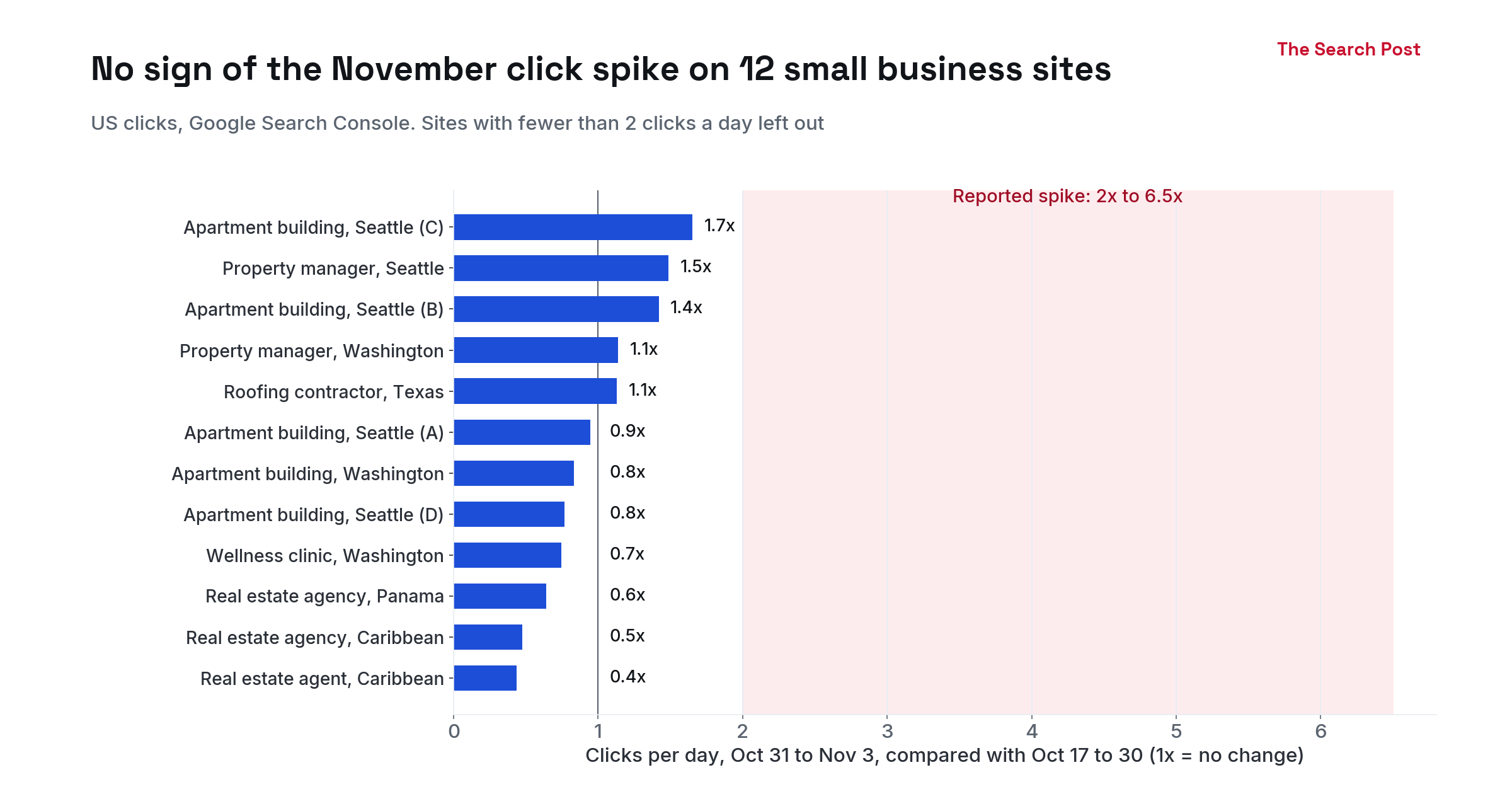
We looked at 16 sites in Search Console, US traffic only, and compared clicks per day from Oct. 31 to Nov. 3 with the two weeks before (Oct. 17 to 30). Four sites get fewer than two clicks a day, too few to read, so we left them out. That leaves 12: apartment buildings, property managers, real estate agencies, a roofing contractor and a wellness clinic.
| Site | Clicks per day, before | During | Change | Desktop share, before to during |
|---|---|---|---|---|
| Apartment building, Seattle (C) | 2.6 | 4.2 | 1.7x | 56% to 65% |
| Property manager, Seattle | 40.1 | 59.8 | 1.5x | 42% to 33% |
| Apartment building, Seattle (B) | 5.3 | 7.5 | 1.4x | 43% to 53% |
| Property manager, Washington | 45.1 | 51.2 | 1.1x | 33% to 28% |
| Roofing contractor, Texas | 41.6 | 47.0 | 1.1x | 42% to 34% |
| Apartment building, Seattle (A) | 12.4 | 11.8 | 0.9x | 41% to 23% |
| Apartment building, Washington | 9.0 | 7.5 | 0.8x | 60% to 60% |
| Apartment building, Seattle (D) | 2.3 | 1.8 | 0.8x | 72% to 43% |
| Wellness clinic, Washington | 3.4 | 2.5 | 0.7x | 23% to 10% |
| Real estate agency, Panama | 5.1 | 3.2 | 0.6x | 39% to 38% |
| Real estate agency, Caribbean | 5.8 | 2.8 | 0.5x | 33% to 27% |
| Real estate agent, Caribbean | 2.3 | 1.0 | 0.4x | 31% to 25% |
None of them reached 2x. The two biggest rises don't fit the pattern either:
- The apartment building at 1.7x went from 2.6 to 4.2 clicks a day. That's a difference of about one and a half clicks, too small to mean much, and none of its clicks came from beyond position 10.
- The Seattle property manager at 1.5x also gained impressions (up 1.2x), its desktop share went down, and only 5% of its clicks came from beyond position 10. That looks like real people, not the reported pattern.
Why some sites saw it and ours didn't
We can only guess. The sites in the original analysis were monitored by an SEO consultant, so they are likely larger and more content-heavy than a local apartment building. If the cause was an AI agent or scraper running searches, it would reach sites that rank for many informational queries far more often than a roofer that ranks for "roof repair near me."
What we can say: if you run a small local business site and your clicks look normal, this probably didn't touch you. If they jumped, check before you celebrate.
How to check your own site in five minutes
In Search Console, open Performance, then Search results, and compare the last 28 days with the previous period.
- Look at the trend lines together. Turn on both Total clicks and Total impressions. A spike in clicks with no matching rise in impressions is the first warning sign.
- Split by device. Open the Devices tab. If the extra clicks are almost all desktop, that's the second sign.
- Check where the clicks rank. In the Pages tab, add a filter for Position greater than 10, then sort by clicks. Real people rarely click results that deep; dozens of clicks there is the third sign.
- Read the queries. In the Queries tab, look for many near-duplicate searches with one impression and one click each.
If all four match, set those dates aside when you report results. You can't remove bot clicks site-wide, but you can filter out the affected pages or countries to see the trend underneath.
One warning if you pull this data through the Search Console API instead: reports grouped by page drop a large share of clicks once you add a country filter. On the sites we tested it was 37% to 87%. Our weekly report tutorial shows how to avoid that.